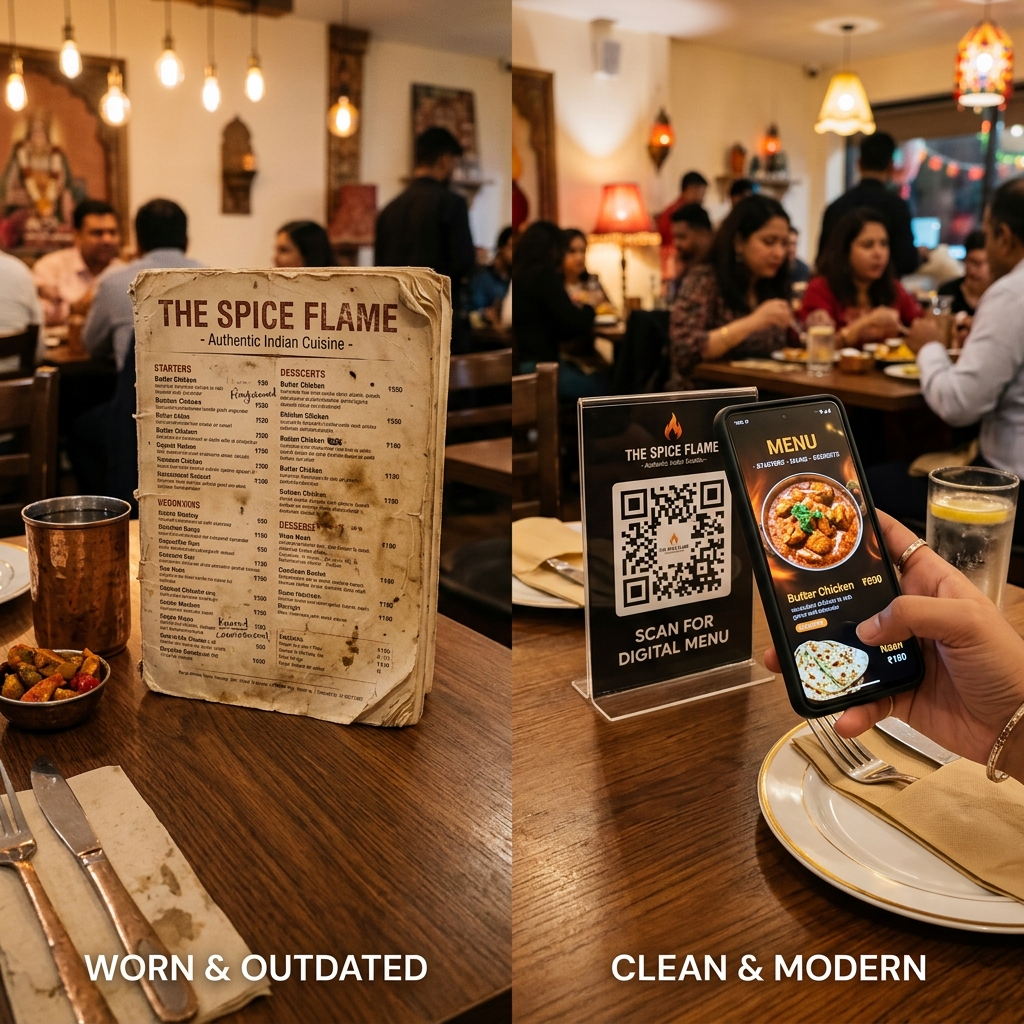
The Great Debate: QR Menu vs Paper Menu in India
If you own or manage a restaurant in India today, you've likely faced this debate. The transition from traditional physical menus to digital QR code menus was initially sparked by pandemic hygiene concerns, but it has now evolved into a permanent operational shift driven by efficiency and cost savings.
But is it the right choice for your specific restaurant? In this comprehensive, 2,500+ word guide, we will break down every single aspect of this decision. We'll look at the hidden costs of paper menus, the revenue-boosting potential of digital menus, customer psychology, and exactly how the numbers stack up over a 3-year period for a typical Indian eatery.
1. The True Cost Breakdown (It's More Than Just Printing)
Most restaurant owners underestimate the true cost of paper menus. They look at the initial printing quote and think, "That's not too bad." But the reality is that paper menus are a recurring, hidden drain on your profitability.
The Hidden Costs of Paper Menus
- Initial Design & Layout: Hiring a graphic designer can cost anywhere from ₹5,000 to ₹15,000.
- High-Quality Printing: For a standard 20-table restaurant requiring 40 menus, printing on durable, spill-resistant paper (like synthetic or laminated sheets) costs ₹8,000 to ₹25,000.
- The "Menu Update" Tax: Ingredients get more expensive. You introduce a new seasonal dish. With a paper menu, you have two choices: cross out old prices with a pen (which looks incredibly unprofessional) or reprint the entire batch. Most restaurants reprint 3-4 times a year. That's an additional ₹20,000+ annually.
- Wear and Tear Replacement: Customers spill gravy. Kids tear pages. Menus go missing. You are constantly replacing worn-out menus.
The Cost of a QR Digital Menu
A premium QR digital menu platform like DineWaves flips this cost structure completely on its head.
- Zero Printing Costs: You print the QR codes once (often provided as stylish acrylic table standees for around ₹150-200 each). Total table setup cost: ₹3,000 - ₹4,000.
- Instant, Free Updates: Need to increase the price of Paneer Butter Masala by ₹20? You do it on your phone, and it reflects instantly across all tables. Cost: ₹0.
- No Wear and Tear: QR standees last for years. The actual menu is safely hosted on the cloud.
- Monthly Subscription: High-end platforms charge a nominal monthly fee (e.g., starting at ₹600/month or ₹7,200/year).
| Expense Item (3-Year Horizon) | Traditional Paper Menu | DineWaves QR Menu |
|---|---|---|
| Initial Design | ₹10,000 | ₹0 (Template based) |
| Initial Printing (40 units / standees) | ₹15,000 | ₹4,000 (Acrylic stands) |
| Updates & Reprints (3x a year) | ₹90,000 | ₹0 |
| Platform / Software Fees | ₹0 | ₹21,600 (Standard Plan) |
| Total 3-Year Cost | ₹1,15,000 | ₹25,600 |
Cost Verdict: Digital menus save the average mid-sized Indian restaurant nearly ₹90,000 every three years.
2. Operational Agility: Speed is Money
In the restaurant business, agility is a superpower. How fast can you adapt to market changes?
The "Out of Stock" Dilemma
Imagine a busy Saturday night. Your kitchen runs out of Tandoori Roti. With a paper menu, customers keep ordering it, and your waiters have to constantly apologize and ask them to choose something else. This creates friction, slows down table turnover, and frustrates diners.
With a QR menu, the restaurant manager simply toggles a switch on their dashboard. The item disappears from the menu (or shows as "Sold Out") instantly. No awkward conversations, no wasted time.
Seasonal Promos and Dynamic Pricing
Want to run a "Monsoon Chai & Pakora" special for just two months? A paper menu requires a separate insert to be designed, printed, and tucked into the main menu. A digital menu lets you create a "Seasonal Specials" category at the very top of your menu in 60 seconds.
Furthermore, digital menus allow for dynamic pricing. You can adjust prices slightly during peak festive seasons without anyone batting an eyelid, exactly like surge pricing on ride-hailing apps.
3. Customer Psychology & Increasing Order Value
This is where digital menus truly shine. A paper menu is essentially a spreadsheet of text. It relies entirely on the customer's imagination.
The Power of Visuals
We eat with our eyes first. High-quality food photography has been proven to increase order volume by up to 30%. However, printing a massive, multi-page booklet with glossy photos of every single dish is prohibitively expensive for paper menus.
Digital menus have zero constraints on space. You can upload a mouth-watering, high-resolution photo for every single item on your menu. When a customer sees a glistening slice of chocolate truffle cake on their phone screen, they are significantly more likely to order it than if they just read the words "Chocolate Truffle - ₹250".
Strategic Upselling
Digital platforms allow for smart upselling. When a customer adds a burger to their cart, a prompt can suggest "Add French Fries and a Coke for ₹149?". This type of automated, frictionless upselling is impossible with static paper.
4. Hygiene and the Modern Indian Diner
Post-2020, hygiene expectations have fundamentally shifted. Traditional paper menus are among the dirtiest items in a restaurant. They are handled by dozens of different people daily, often with unwashed hands, and are rarely sanitized properly between uses (as moisture damages the paper or lamination over time).
A recent survey of urban Indian diners revealed that 74% prefer scanning a QR code simply because they don't want to touch a physical menu. This is particularly prevalent in metropolitan areas like Mumbai, Delhi, and Bangalore.
5. When Paper Menus Still Make Sense (The Exceptions)
Despite the overwhelming advantages of digital menus, we must be objective. There are specific scenarios where paper menus still hold their ground.
- Ultra-Fine Dining: If you run an exclusive, ₹10,000-per-head fine dining establishment, handing the customer a heavy, leather-bound menu is part of the tactile, premium experience. In these settings, the high cost of printing is absorbed by the high margins of the food.
- Elderly Demographics: If your restaurant primarily caters to senior citizens who may not be comfortable with smartphones, forcing a QR menu can create a barrier to entry.
- Locations with Zero Network: If your café is in a remote Himalayan valley with zero 4G/5G coverage and no reliable Wi-Fi, a cloud-based QR menu will simply not load.
6. The Hybrid Approach: The Perfect Transition Strategy
For restaurants worried about alienating customers, the "Hybrid Strategy" is the safest bet. It involves placing a prominent QR code standee on every table, but keeping 3 to 4 paper menus at the cashier's desk.
When customers sit down, 85% will naturally scan the code. For the 15% who ask for a physical menu, the waiter can provide one. This drastically reduces the wear-and-tear on your paper menus (meaning you don't need to print 40 of them, just 5), while still transitioning your customer base to the digital platform.
Conclusion: The Inevitable Digital Shift
The debate between QR menus and paper menus in India is settling. The cost savings, operational agility, and revenue-boosting potential of digital platforms like DineWaves are simply too large to ignore.
Just as digital payments replaced cash, digital menus are rapidly replacing paper. For the modern Indian restaurateur looking to optimize costs and enhance the customer experience, the digital leap is no longer optional—it is essential for survival and growth.
Ready to make the switch?
Join hundreds of top Indian restaurants already growing their revenue with DineWaves's premium digital menus.
Build Your Free Menu Today